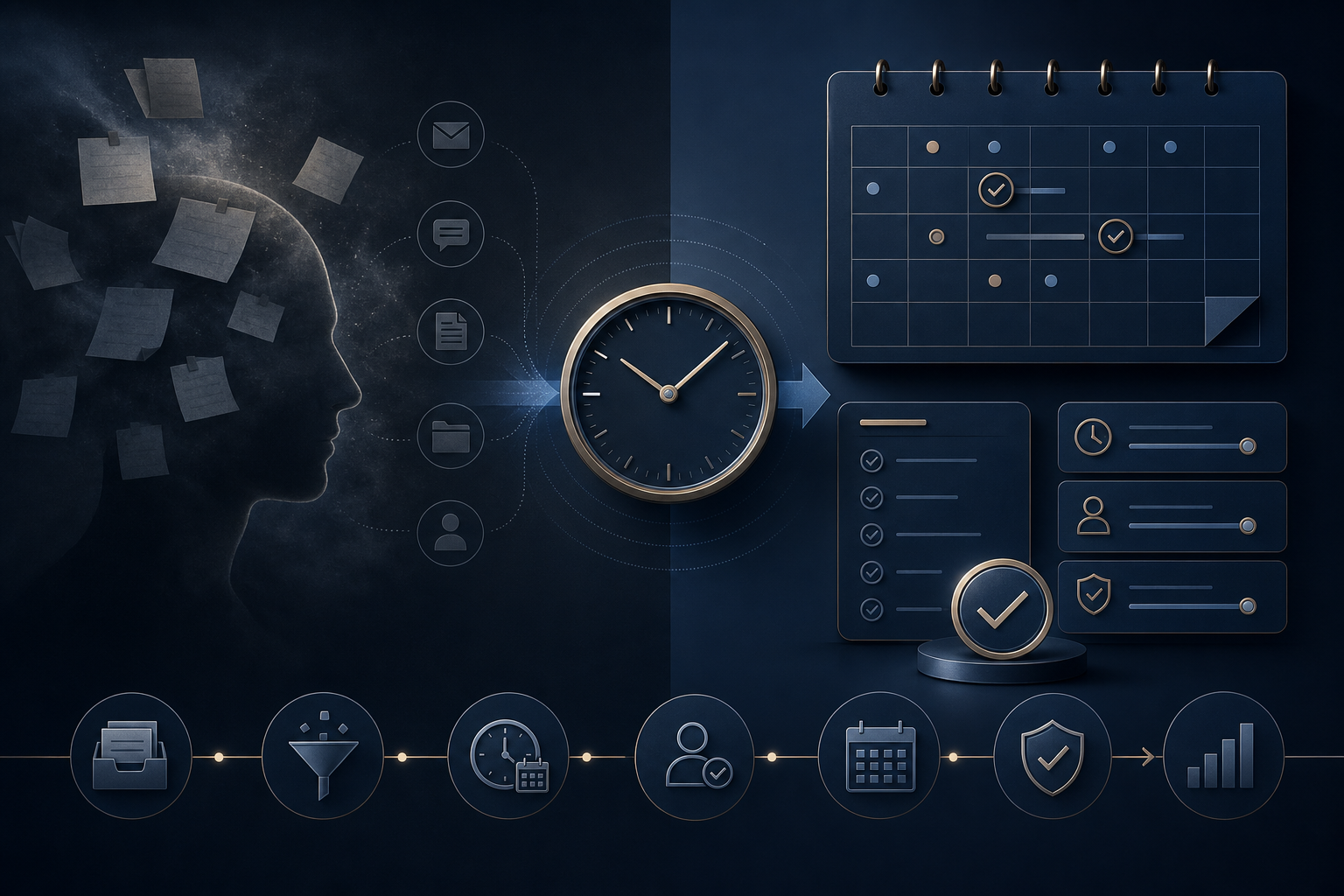
Many operational misses are not judgment failures. They are deferred-ownership failures.
Businesses often talk about execution problems as if they are failures of intelligence or strategy. Sometimes they are. Just as often, the system already understands what is happening and still fails because nobody explicitly owns the next check. The diagnosis is correct. The recommended next action is obvious. The only thing missing is a mechanism that ensures the action actually happens when the time comes.
This matters most in transitional states: DNS propagation, certificate issuance, queued deployments, asynchronous imports, vendor confirmations, payment references, compliance follow-ups, and all the other situations where the next useful step is not immediate intervention but later verification. These are not empty waiting periods. They are structured operational dependencies.
If the dependency is time, memory is a weak control surface
In many firms, those dependencies are still carried informally. Someone is expected to remember to check again in an hour, later that afternoon, or tomorrow morning. That seems harmless until the business is busy. Then the memory burden lands on exactly the people who are already oversubscribed. The result is familiar: more chasing, more uncertainty, and more invisible administrative residue around work that was supposedly already under control.
This is why deferred verification should be treated as an ownership problem rather than a courtesy problem. If the next likely state change depends mainly on time, then “remember to check later” is not an operating system. It is an unmanaged handoff to human memory.
Good systems turn waiting states into explicit watchpoints
A stronger approach is simple. Convert the waiting state into a named watchpoint. Assign a time window. Assign the mechanism that will perform or surface the re-check. Sometimes that mechanism is a one-shot reminder. Sometimes it is a scheduled job. Sometimes it is a watchdog or a review queue. The point is not the specific tool. The point is that the system should absorb the obligation instead of leaving it ambient.
That shift has an outsized effect on trust because it improves the part of execution that many teams still handle most casually: the interval between “it should settle naturally” and “we have now confirmed that it did.” In practice, that interval is where a lot of work quietly stalls.
Verification is not only about proving success. It is about carrying continuity.
Leaders often underestimate how much follow-through quality depends on continuity rather than insight. A system may already know which result is likely. That does not remove the need to return and confirm the actual state on the exact surface that matters. In other words, the system should not only reason forward. It should also carry the thread forward.
This is one reason Nordlith treats verification as a business-control problem rather than a narrow QA concern. Verification governs who is allowed to claim completion, which surface counts as truth, and whether the organisation is reducing uncertainty or merely narrating around it. Deferred verification extends that same principle into time-delayed states. The question becomes: who owns the later confirmation?
What mature operational design does differently
Mature operational design distinguishes between four states clearly:
- the change was made
- the result is expected to settle later
- the later check is scheduled and owned
- the final state has been verified on the correct surface
Many organisations stop after the first or second line. Stronger organisations close the third and fourth as well. That is where confidence becomes justified rather than merely optimistic.
The institutional lesson
When businesses talk about reducing operational drag, they often focus on dashboards, meetings, and tooling. Those matter. So does something smaller and more structural: whether the system knows how to carry deferred checks without relying on informal human recall. That is not just convenience. It is part of execution discipline.
The institutional lesson is straightforward. If a future check is predictable, the system should usually own it explicitly. Otherwise the cost does not disappear. It simply moves into someone’s head, where it competes with everything else.