
What business AI integration actually means
Originally published 2026-09-11. Historical observations remain as published; they are not current performance claims.
Contents
Business AI integration is not the purchase of a software licence or the deployment of a chatbot. It is the governed connection of an AI capability to a specific business problem, using authoritative records, defined workflow rules, and clear human authority. This article provides a direct operational definition and a seven-layer model to distinguish a useful integration from an isolated tool.
What business AI integration actually means
Business AI integration is not the purchase of a software licence or the deployment of a chatbot. It is the governed connection of an AI capability to a specific business problem, using authoritative records, defined workflow rules, and clear human authority. This article provides a direct operational definition and a seven-layer model to distinguish a useful integration from an isolated tool.
What business AI integration means
At its core, integration means that the AI does not work in a vacuum. It draws on the records the business already trusts, follows rules designed for the workflow, and stops where a person must decide. The Australian Government’s business.gov.au guidance advises organisations to identify the business problem before choosing a solution, start small, check outputs, maintain human oversight, and document AI systems. Those are sensible foundations for an operational integration.
An isolated chatbot sits outside that operating chain. It can still be useful for drafting or exploring an idea, but it has no governed connection to the records, rules and approvals that move work through the business. The distinction is not whether the technology looks impressive. It is whether the capability has been fitted into a controlled process.
The seven layers of a working integration
Nordlith treats integration as a governed operating layer. This is a Nordlith synthesis, not a verbatim government checklist. It is designed to help leaders evaluate whether a proposed AI use case is actually an integration or just a tool. The seven layers are:
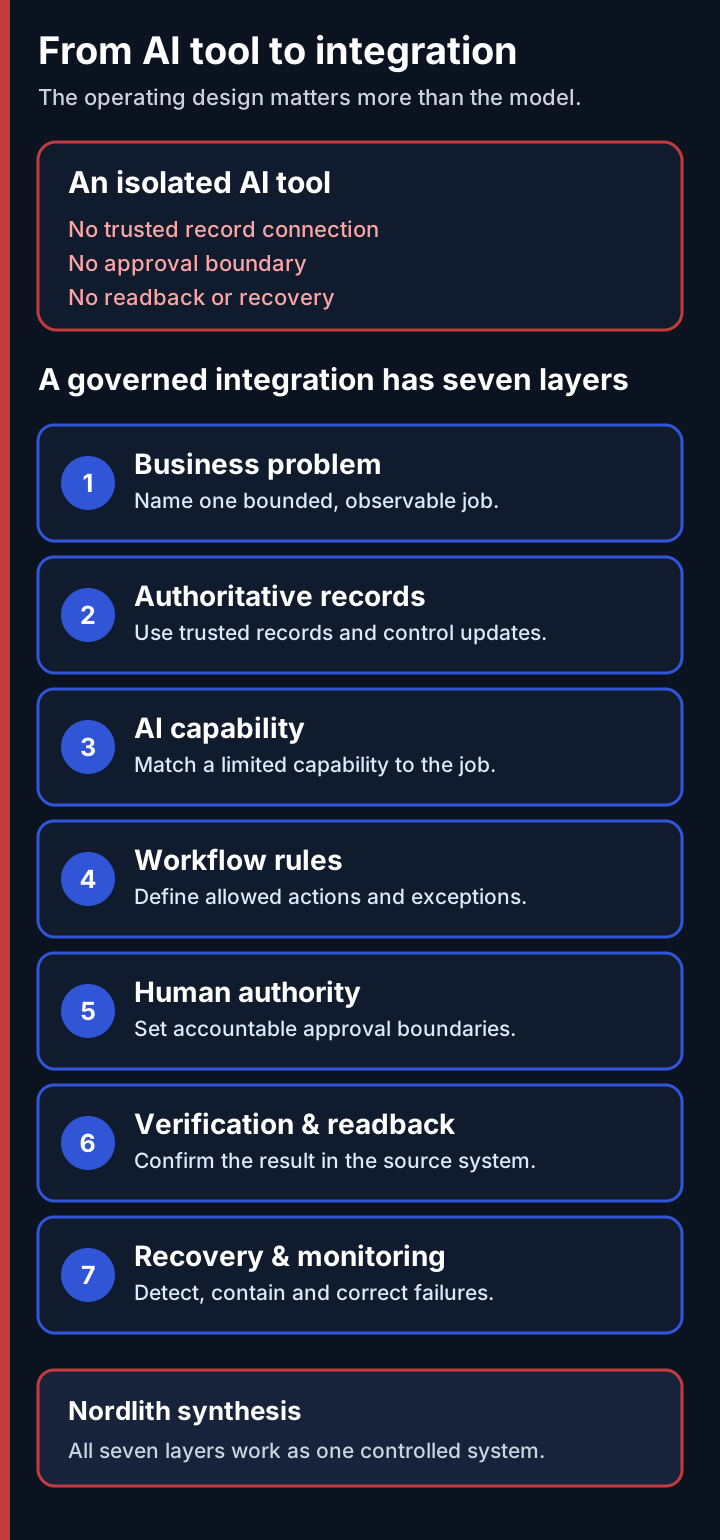
1. Business problem. The integration must solve a specific, recurring operational issue. It is not a general-purpose assistant. The problem must be bounded and observable.
2. Authoritative records. The AI should receive information from the system of record and write back only where that action is deliberately authorised. Fragmented or unreliable data makes every downstream answer harder to trust. The National AI Centre emphasises connecting AI use to business outcomes and establishing governance roles and controls before scaling.
3. AI capability. The specific function the AI performs. This could be classification, drafting, summarisation, or prediction. The capability must be matched to the problem.
4. Workflow rules. The logic that governs how the AI interacts with the business process. These rules must be explicit and documented.
5. Human authority. The point at which the workflow pauses for an accountable person. The higher the consequence, the clearer that approval boundary needs to be.
6. Verification and readback. The process for checking the result against authoritative records after the proposed action. A readback does not promise perfection; it provides evidence that the intended state was, or was not, reached.
7. Recovery and monitoring. The mechanism for detecting and correcting errors after they have occurred. This includes logging, alerting, and the ability to roll back changes.
What AI may do and where authority stays human
The boundary between capability and authority deserves more attention than the model itself. The Office of the Australian Information Commissioner notes that privacy obligations can apply when personal information appears in AI inputs or outputs, and advises due diligence and appropriate safeguards. A useful design therefore states which steps the AI may prepare or perform, which need approval, and what evidence is retained.
An AI might draft a customer response, categorise a support ticket or flag an order for review. Whether it may send, close or approve depends on the consequence, the organisation’s policy and the controls around the action. In many practical first deployments, those consequential steps remain human-approved. The point is to make the boundary explicit rather than allowing it to emerge by accident.
Privacy-safe patterns from operational work
The following patterns are derived from Nordlith’s operational work. They are anonymised to sector-level architecture and controls. They do not identify clients, people, systems by confidential name, volumes, financial values, or unapproved outcomes.
Field service. In this pattern, the AI integrates with the scheduling system. It reads job details, location data, and technician availability. It drafts a schedule for review. The human dispatcher approves the schedule. The AI does not assign jobs directly. This preserves the system of record and maintains human authority over resource allocation.
Distribution and order operations. Here, the AI integrates with the order management and accounting systems. It reconciles orders against stock and pricing data. It flags discrepancies for review. The human operations manager resolves the discrepancies. The AI does not adjust prices or release stock. This ensures that financial records remain authoritative and that errors are caught before they propagate.
Executive follow-through. In this pattern, the AI integrates with the email and meeting systems. It summarises meeting notes and drafts follow-up actions. The executive reviews and approves the actions. The AI does not send emails or create tasks directly. This maintains the executive’s authority over their own commitments and ensures that follow-through is intentional.
A buyer checklist
When evaluating a proposed AI integration, use this checklist to determine whether it is a governed operating layer or an isolated tool:
- Is the business problem specific and recurring?
- Does the AI receive authoritative data, and is any writeback deliberately authorised?
- Are the workflow rules explicit and documented?
- Is there a clear point where human authority takes over?
- Is there a verification step that checks the output against authoritative records?
- Is there a recovery mechanism for detecting and correcting errors?
- Is the AI’s use of personal information assessed for privacy obligations?
A “no” does not automatically kill the idea. It shows where the proposal is still a tool, where design work remains, or where the risk may be too high. Isolated tools have their place; they simply should not be mistaken for an operational integration.
Sources and scope
The claims in this article are grounded in the following sources:
- Australian Government business.gov.au: Artificial intelligence (AI). This source provides general business guidance on identifying the business problem, starting small, and maintaining human oversight.
- National AI Centre: Essential AI practices. This source provides guidance on connecting AI use to business outcomes and establishing governance roles before scaling.
- Office of the Australian Information Commissioner: Guidance on privacy and the use of commercially available AI products. This source provides guidance on privacy obligations and human oversight.
The seven-layer model and the privacy-safe patterns are a Nordlith synthesis. They are not verbatim government checklists. They are designed to help leaders evaluate a specific task against operational reality.
What the evidence does not prove
The sources cited here provide guidance, not guarantees. They do not prove a return on investment, productivity gain or causal outcome for a particular use case. Nor do they establish that a workflow is ready for AI. Readiness still depends on the records, rules, authority boundaries and failure modes of that specific operation.
The seven-layer model is therefore a decision aid, not a certification. Some workflows may justify tightly controlled automation; others should remain advisory or entirely human. A credible integration proposal makes that trade-off visible before implementation begins.
If you are considering an AI integration for your organisation, the next step is to identify a specific business problem and evaluate it against the seven-layer model. Start the inquiry to discuss how a governed operating layer can be applied to your operational context. For more on the broader context, see Business AI Integration and Capabilities.